

Chapter I
Staring into the void
Every couple of years I stare into the void and ask myself: what the hell do I want to do?
It usually happens at the end of a venture. I have always been someone who builds, and that pull led me naturally into startups. But ventures have a limited lifespan. They either grow or they die. When one dies, or when your belief in it does, the attention that was fully on it has nowhere to go, and a turmoil of thoughts surfaces.
My way of putting order in that turmoil has always been writing. I have always written in public too, but for work: journalism, then SEO, interviews, content. Never my own applied philosophical thoughts. Four acquaintances of mine pushed me to start, and they don't know it yet: Lucabrando Sanfilippo and ora di pensiero, as they write about spirituality and tech; vixi, who describes perfectly the VC madness everybody thinks and few write down; and Andrea Zorzetto's It's time for builders, whom I started reading sporadically while he was still wondering what to do, before Cato, a little bit after shutting down his own venture.
Now that credits are given, let us circle back to the main question: why do we want to build?
Startup people love "first principles thinking". It means refusing to reason by analogy ("others do it this way, so I will") and digging down to the most basic truth, the one you cannot derive from anything simpler, then rebuilding from there. It is a buzzword because it is easy to say and brutally hard to practice.
The idea is far older than Silicon Valley. Aristotle opened his Ethics with an observation: every action aims at some good. Thomas Aquinas, the thirteenth century theologian who fused Aristotle with Christian thought, took that observation and made it the first principle of all practical reasoning, the point from which any reflection on how to act has to start.
Take the desire to build and ask why. Then ask why of the answer, and again, until you reach a reason that needs no further reason.
Applied to our question, the method is simple. Aquinas calls that reason the last end. Finding it is the first principle we are after.
Chapter II
Building startups as sublimation and/or will to power
I asked Leo, a fellow founder, why he thinks people build startups. He answered: "because of childhood trauma." I understand that line of thinking. The underlying idea is that building is an act of will to power: a kid who wants to show he exists by achieving great things. Ambition as a way to get noticed, to exist. Two thinkers shaped that line of thinking more than any others.
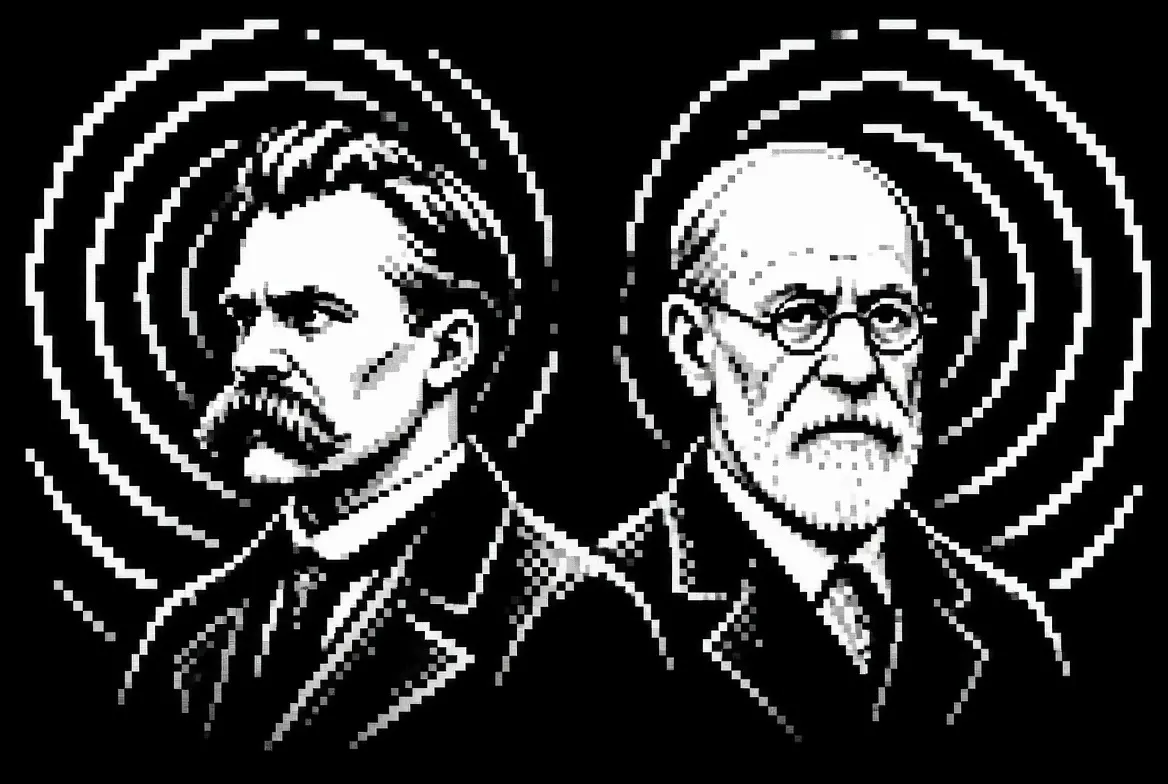
The first is Friedrich Nietzsche, the nineteenth century German philosopher. He argued that the deepest drive in living things is the will to power. It is often misread as the wish to dominate others. He meant something closer to growth: the striving to expand your own strength by pushing through resistance, and above all to overcome yourself, which he called self-overcoming.
Happiness is the feeling of power increasing as you get past an obstacle.
Friedrich Nietzsche
At the far end of this path stands the Übermensch, the Overman. He is the person who stops borrowing inherited values, creates his own, and keeps remaking himself through struggle. Nietzsche set him against the "last man", the comfortable one who wants no risk. A founder looks a lot like the Overman: someone who chooses resistance and rebuilds himself through it.
The second is Sigmund Freud, the Austrian founder of psychoanalysis. He introduced the idea of sublimation. His claim was that our instincts, the sexual and aggressive ones above all, cannot be discharged directly because society forbids it. Their energy is redirected into activities society values: art, science, intellectual work. Freud believed civilization itself depends on this redirection, and he considered it a mature, healthy way to handle a drive. Seen this way, a startup is where wound and drive get channeled into building instead of finding a worse outlet.
Chapter III
Building startups as shaping society
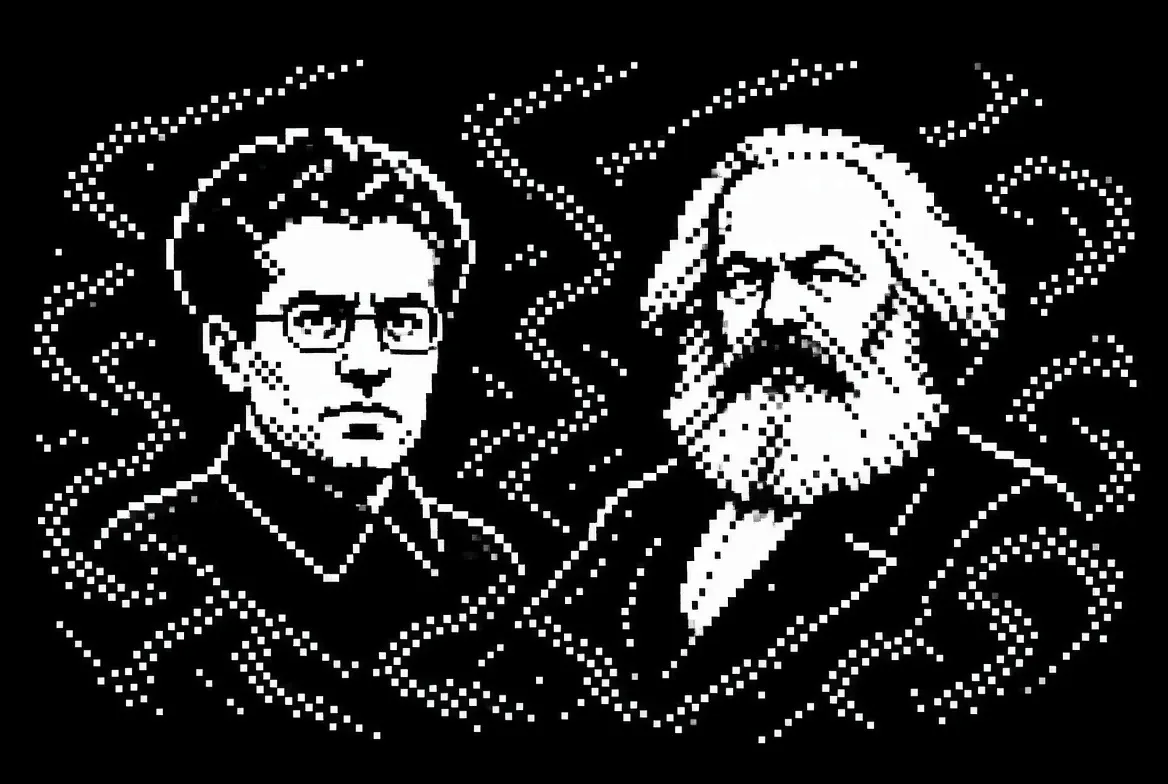
A past, long conversation on why we build startups with Alexandros Fokianos took me somewhere else entirely, toward Antonio Gramsci. Gramsci was an Italian Marxist jailed by Mussolini's regime, and he wrote the Prison Notebooks from his cell. His key idea was hegemony: a class rules not by force alone, but when its worldview becomes the common sense of the whole society, so that the ruled consent to being ruled. Alex reads building through this lens. A startup is a ladder between classes: a way to climb out of the one you were born into and, once up, to shape what people use, believe and take for granted.
Gramsci knew where to look for a model of how this works: the Catholic Church, which he studied in the Prison Notebooks as the institution with the longest experience of ruling through consent rather than force. Its tools were language, myth and figures to imitate. The Italian medieval historian Alessandro Barbero noticed that startup culture runs on the same tools, borrowed straight from the monasteries. He made the point in a 2016 piece for La Stampa. He asked us to imagine a global organization founded by a young, charismatic visionary, who became a myth after his death and whose followers are recognizable at a glance by their look.
Apple and Steve Jobs? No, he answered: Saint Francis and the Franciscan Order.
The parallels between medieval religious orders and today's corporations are so close, he wrote, that one wonders whether the corporations borrowed from them on purpose. Every marketing document now leans on the words vision and mission, which come straight from the vocabulary of friars and monks. The same family includes the founder himself, and in tech even the evangelist. A mission was originally something you were sent to do, and an evangelist was someone who announced good news.
Read through Gramsci, this is no accident. A class that wants consent and not only obedience needs a language in which its power looks like a vocation, and the oldest such language belongs to the Church. People accept long hours and a blurred line between work and life when the work is called a mission instead of a job. That is hegemony at work: the founder's worldview becomes the common sense of everyone around him, and the monastic vocabulary is how it spreads.
Chapter IV
Applying first principle thinking to startup & product building
Now that we have gathered a few potential answers to "why building", let's run the first principles test on them. Freud's drive is a push, and a push has no destination of its own. Gramsci's power is a means: power to shape society, but into what? This is the limit of historical materialism, a fight for a better world through means of power where "better" and "good" cannot be defined ontologically.
Nietzsche comes closest to a last end, because for him power is wanted for itself. But look at what his Overman does with it: he creates values. Power is the tool, and the values he makes are the point. Even in Nietzsche, power ends up serving meaning. But since meaning has no fixed value in his worldview, the Overman is damned to fall into the trap of nihilism and relativism he set out to escape.
Every agent, of necessity, acts for an end.
Thomas Aquinas
Aquinas put it simply. Nothing we do is aimless. Every action is pulled toward something, and that something is always seen as a good, even when we are mistaken about it. Maximus the Confessor, a seventh century monk and writer whose tongue the emperor had cut out and whose writing hand he had cut off, says the same from the other side: all motion is movement toward the end proper to a nature, and the end of everything is where it finds its rest. So the chain of whys has to stop at a good wanted for its own sake, and a drive or a ladder cannot be that good.

Chapter V
Building startups as man's search for meaning
So why building? Why building products, startups, games? Because of meaning. Try the test on it: why do you want your life to mean something? The question sounds strange, because there is nothing further to point to. I do not think we build for ego, vainglory or money. We build because of meaning, and we build despite suffering.
The best evidence I know comes from Viktor Frankl, an Austrian psychiatrist who survived Auschwitz, where he lost his parents, his brother and his pregnant wife. There, with pleasure, power and status all stripped away, he watched what still helped people endure. He came out convinced that the leading psychological theories of his time were incomplete, and he had two in mind: Freud, who said humans are driven by pleasure, and Adler, who said by power, an idea close to Nietzsche's. Frankl said both come second. What comes first is the will to meaning: the need to find a reason for one's life. He called his approach logotherapy, from logos, the Greek word for reason and sense. A therapy of meaning.
That is also why he turned the usual question around. We should stop asking what life owes us, because, as he put it, "each man is questioned by life." Life asks, and we answer with what we do. He liked a line from Nietzsche on this.
He who has a why to live for can bear almost any how.
Friedrich Nietzsche, quoted by Viktor Frankl
Anyone who has built a company knows how many hows it demands. Only a deep enough why carries you through them.
So building is logotherapy: a cry for meaning, and one way of answering life's question.
Chapter VI
Building startups as sub-creation
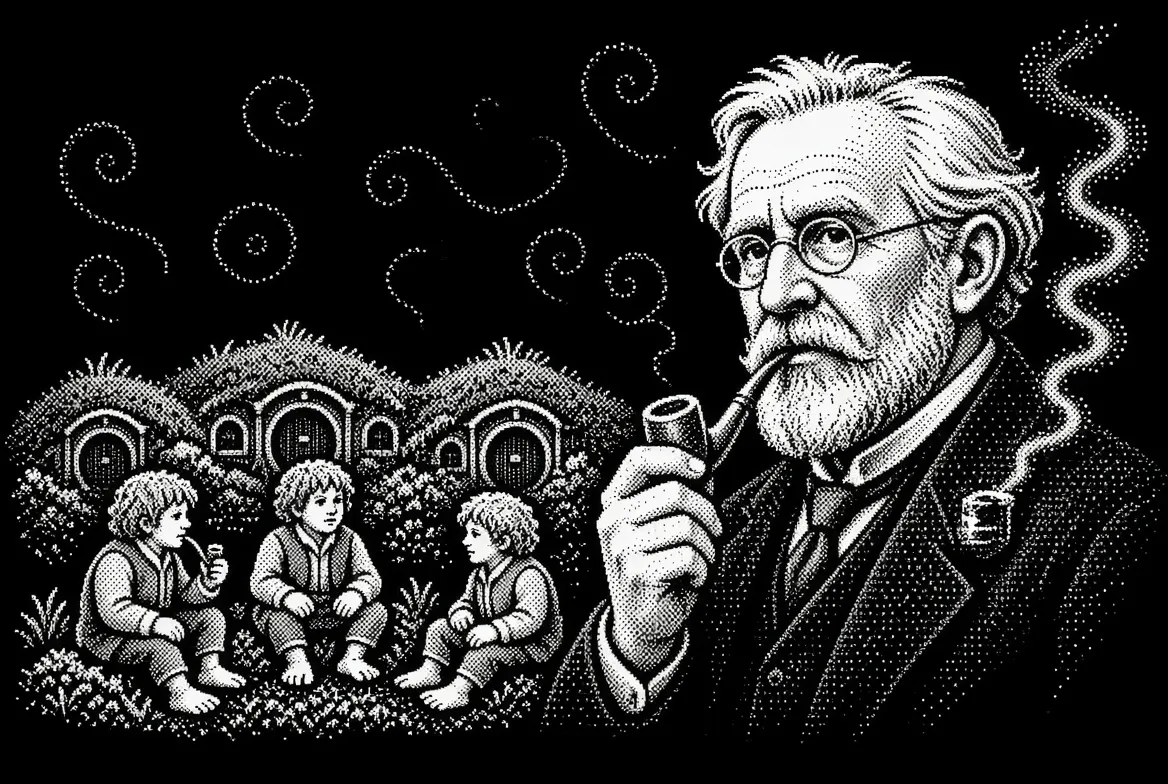
But why answer by building, by creating? Here J.R.R. Tolkien helps. He is the author of The Lord of the Rings, and he was also an Oxford professor of language. He coined the idea of sub-creation. Only God creates from nothing, but humans, made in His image, create in a smaller, derivative way. In his words, "we make in our measure and in our derivative mode, because we are made."
We build because we are built.
And if meaning is what we are made for, I suspect this is why building feels like a search for it.
Tolkien described art as "the operative link between Imagination and the final result, Sub-creation." It is the bridge between what you picture and what exists. That is a founder's job. The Torah has a name for the same kind of work: melachah, the work forbidden on Shabbat. It is not defined by effort. You can tire yourself out all day and produce no melachah, while the smallest purposeful change to an object counts as one. What defines it is that it is creative and constructive, done with consciousness, intention and purpose. But what does that creating look like in practice?
Genesis answers it. The story opens on tohu vavohu, chaos and void, and the six days that follow are an act of ordering: light from darkness, water from land.
The first creative work is making order out of chaos.
tohu vavohu
If we build because we are built, in that image, then the work we inherit is the same. Writing is that gesture on a small scale, it is how I put order in my own turmoil. Building is the same gesture applied to someone else's, because every real problem is a small piece of chaos in somebody's life.
Startups already know this, under a different name: jobs to be done. Intercom turned it into job stories: when [situation], I want [motivation], so I can [outcome]. Read it as ordering: a situation where something is out of place, a motivation to fix it, an outcome where it is back in place. Y Combinator says the same in four words: make something people want.
A founder does not need a brilliant idea. A founder needs a piece of someone's chaos that they cannot walk past.
Chapter VII
Building startups as applied philosophy
Looking for meaning, then, means practicing philosophy. Building products and startups is a school of virtues, meaning habits of character trained through repetition, like a muscle. I think of seven.
- Hope is expecting good despite fear.
- Faith is trusting good despite suffering.
- Love is willing good despite hurt.
- Prudence is discerning good despite confusion.
- Justice is giving each their due despite convenience.
- Fortitude is holding good despite danger.
- Temperance is keeping measure despite impulse.
If you hold to meaning, sooner or later you build something great, because meaning makes you look at someone else's chaos instead of your own reflection. If you don't, you dance a VC drama: the narrative, the deck, the round. And you fail anyway, because faking is a recipe for a postponed disaster.
Hope, Faith and Love are all that matter.
Building, writing, reading and crafting narratives keep those gentle flames alive. This is what I seek in every venture. This is, I believe, why people want to build.